
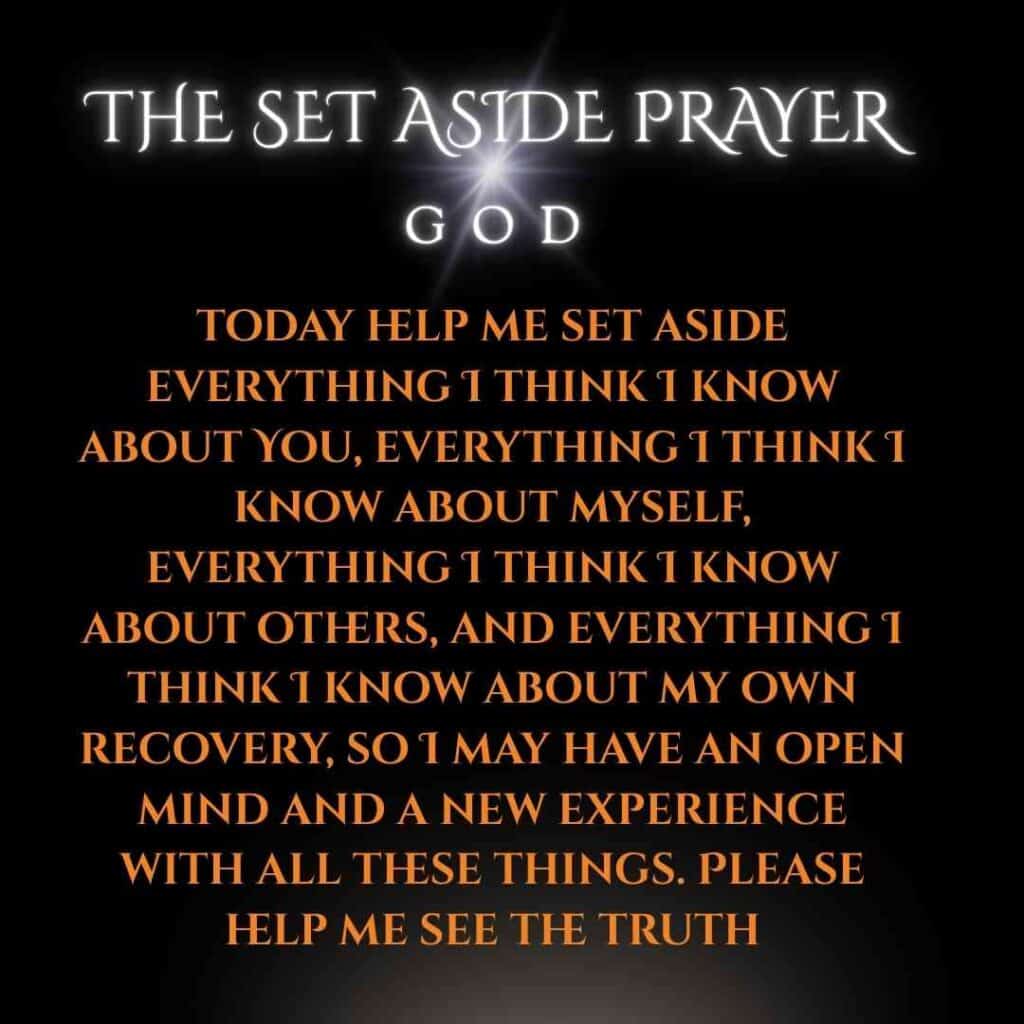

Why the Set Aside Prayer is the Ultimate Tool for a “Beginner’s Mind”
If you feel spiritually stuck or mentally exhausted, the set-aside prayer might be the most important practice you adopt this year. Most of us approach our problems with a mind full of old baggage and preconceived notions. We think we already know why things are failing, but this “knowing” is often what keeps us trapped. By using this specific request for humility, we intentionally ask to clear our mental slate so we can see the world with fresh eyes.
In 2026, the world is louder than ever. Our “knowledge” is often just a collection of biases we’ve picked up from social media algorithms and past traumas. When we utilize the set-aside prayer, we aren’t just reciting words; we are engaging in a radical act of cognitive and spiritual rebellion. We are telling our ego to take a backseat so that truth can finally drive.
The Benefit of an “Empty Cup” Mentality

It isn’t enough to recite words and hope for a miracle. True transformation comes from the depth of your intent when you utilize the set-aside prayer rather than how many times you repeat a phrase. This is often referred to as the “Empty Cup” philosophy. In Zen tradition, a scholar once visited a master to inquire about Zen. The master poured tea until the cup overflowed. When the scholar protested, the master replied, “Like this cup, you are full of your own opinions. How can I show you Zen unless you first empty your cup?”
The set-aside prayer is the tool we use to pour out that stale tea. When this spiritual reset becomes a frequent “pattern interrupt,” you begin to see growth opportunities where you previously only saw obstacles.
Beyond What You Know: A Deep Dive into the Set Aside Prayer
We’ve all been there. You sit down to pray or meditate, and you’re immediately flooded with certainty. You already know who’s to blame, you know why you’re angry, and you’re sure you know exactly how the universe should fix it. This is the paradox of spiritual growth: the more we think we know, the less we can learn.
The Theological Depth of the Set Aside Prayer
At its heart, this invocation is an appeal for spiritual receptivity. While its exact phrasing can vary, the version most common in recovery circles goes like this:
“God, please set aside everything I think I know about myself, my disease, these steps, and especially You; for an open mind and a new experience of myself, my disease, these steps, and especially You.”
It isn’t a request for “stuff.” It’s an appeal for emptiness. It is a recognition that our best thinking is what got us into our current mess. To get out of the mess, we need a “New Experience”—a phrase that is central to the set-aside prayer.
Information Gain: Why the Set Aside Prayer Beats Confirmation Bias
In the world of SEO and psychology, “information gain” is the value of adding something new to a conversation. In your personal life, the set-aside prayer creates internal information gain. By silencing the “old” voices, you allow new insights to surface.
Breaking the Cycle of Confirmation Bias
Confirmation bias is the human tendency to seek out information that supports what we already believe. If you believe you are unlovable, you will find evidence for it in every missed text message. If you believe your recovery is impossible, you will find “proof” in every craving.
The set-aside prayer is a direct attack on this bias. By asking to set aside what you “think you know” about yourself, you disrupt the neural pathways that keep you stuck in the same old story.
Why 2026 is the Year to Set Aside Old Beliefs
We live in an age of curated reality. Our phones show us what we like, and our social circles echo our opinions. This makes the set-aside prayer more than a spiritual tradition; it is a mental health necessity. It forces us to acknowledge that our perspective is limited. It humbles us. In a world of “influencers” and “experts,” there is a quiet power in being a student again.
Historical Origins: Where Did the Set-Aside Prayer Come From?
While many attribute the set-aside prayer directly to the “Big Book” of Alcoholics Anonymous, the specific wording we use today evolved. It is largely derived from the principles found in the Doctor’s Opinion and Appendix II on Spiritual Experience.
Early members of recovery fellowships realized that many people failed to recover because they were “contemptuous of spiritual principles” before they even tried them. They had a “prejudice” against God or a “fixed idea” about how the program worked. The set-aside prayer was developed as a remedy for this prejudice. It allowed people who were skeptical or “too smart for their own good” to lower their guard just long enough for a transformation to occur.
Practical Steps: How to Practice the Set-Aside Prayer Daily
Understanding the theory is one thing; living it is another. To get the full 1,500-word value of this practice, we must look at how it applies to real-world friction.
1. Using the Set Aside Prayer as a Morning Threshold
The first five minutes of your day are the most critical for your “spiritual alignment.” Instead of reaching for your phone and filling your mind with news and notifications, try this invocation.
-
The Action: Sit on the edge of your bed. Before your feet hit the floor, recite the prayer.
-
The Intent: You are telling your brain, “I am entering this day as a beginner. I don’t know what today holds, and that is okay.”
2. The “Conflict Reset” with the Set Aside Prayer
Arguments are the graveyard of spiritual progress. When we are in a conflict, our ego is in “survival mode.” It wants to win.
-
The Action: When you feel your heart rate rise, pause.
-
The Intent: Say to yourself, “God, set aside everything I think I know about this person.” This is revolutionary. When you set aside your “knowledge” that your partner is being “difficult” or “lazy,” you might actually hear the pain or fear behind their words.
3. Approaching Recovery Steps and Spiritual Study
For those in a 12-step program, the set-aside prayer is often used before reading the “Big Book” or meeting with a sponsor.
-
The Problem: “I’ve read this a hundred times.”
-
The Solution: By asking for a new experience of the steps, you allow the text to speak to who you are today, not who you were five years ago.
The Psychological Mechanics: How it Affects the Brain

If you are a secular practitioner, you might wonder how the set-aside prayer works without a traditional “God.” From a neurological standpoint, this prayer is a form of cognitive reframing.
-
Lowering the Amygdala Response: By admitting we don’t know everything, we reduce the “threat” of being wrong. This moves us out of a “fight or flight” state and into the prefrontal cortex, where logic and empathy live.
-
Neuroplasticity: Each time we consciously choose to “set aside” an old belief, we are weakening that neural connection and making room for a new one.
-
Mindfulness: The prayer is essentially a high-intensity form of mindfulness. It brings you into the present moment by stripping away the past (what you know) and the future (your expectations).
Common Obstacles: Why We Resist the Set-Aside Prayer
If this practice is so powerful, why don’t we do it all the time? Because the ego views the set-aside prayer as a death sentence.
-
The Fear of the Void: If I don’t “know” who I am or what I believe, am I even real? We cling to our labels—even the painful ones—because they feel safe.
-
The Need for Control: Knowledge is control. If I know what’s going to happen, I feel safe. The set-aside prayer requires us to trade the illusion of control for the reality of faith.
-
Intellectual Pride: This is the “smartest person in the room” syndrome. We feel that by admitting we don’t know, we are losing status. In reality, the most respected people are those who are willing to say, “I could be wrong.”
Expanding the Circle: The Set Aside Prayer in Relationships
Perhaps the most profound application of the set-aside prayer is in our relationships.
When you apply this spiritual tool to a relationship, you are essentially saying, “I am willing to meet you for the first time, every time.” This prevents resentment from building and allows for a level of intimacy that “certainty” prevents.
The Power of the Set-Aside Prayer
The set-aside prayer is more than just a recovery slogan; it is a foundational shift in how we relate to reality. It is the spiritual equivalent of clearing your browser’s cache. By intentionally letting go of our outdated “knowledge,” we make room for a reality that is much bigger, kinder, and more effective than the one we’ve been trying to manage on our own.
As we move through 2026, let this be your secret weapon. When the world feels too heavy, or your path feels too dark, remember that you don’t need more information. You need more room. You need to set aside the old to make way for the new.
FAQ: Common Questions About the Set Aside Prayer
Is the set-aside prayer only for Alcoholics Anonymous?
No. While it became popular in 12-step fellowships, its principles of humility and “beginner’s mind” are universal. It is used by CEOs, therapists, and artists to spark creativity and empathy.
What if I don’t believe in “God”?
The set-aside prayer is just as effective if you address it to “The Universe,” “Truth,” or your “Higher Self.” The power lies in the act of setting aside your ego, not the name of the power you call upon.
How do I know if it’s working?
You will notice a “softening” in your interactions. You’ll be less likely to argue and more likely to listen. You’ll feel a sense of curiosity replace your sense of dread.


Pingback: The Set Aside Prayer : A Guide to Spiritual Openness - thesaturdayblessings