
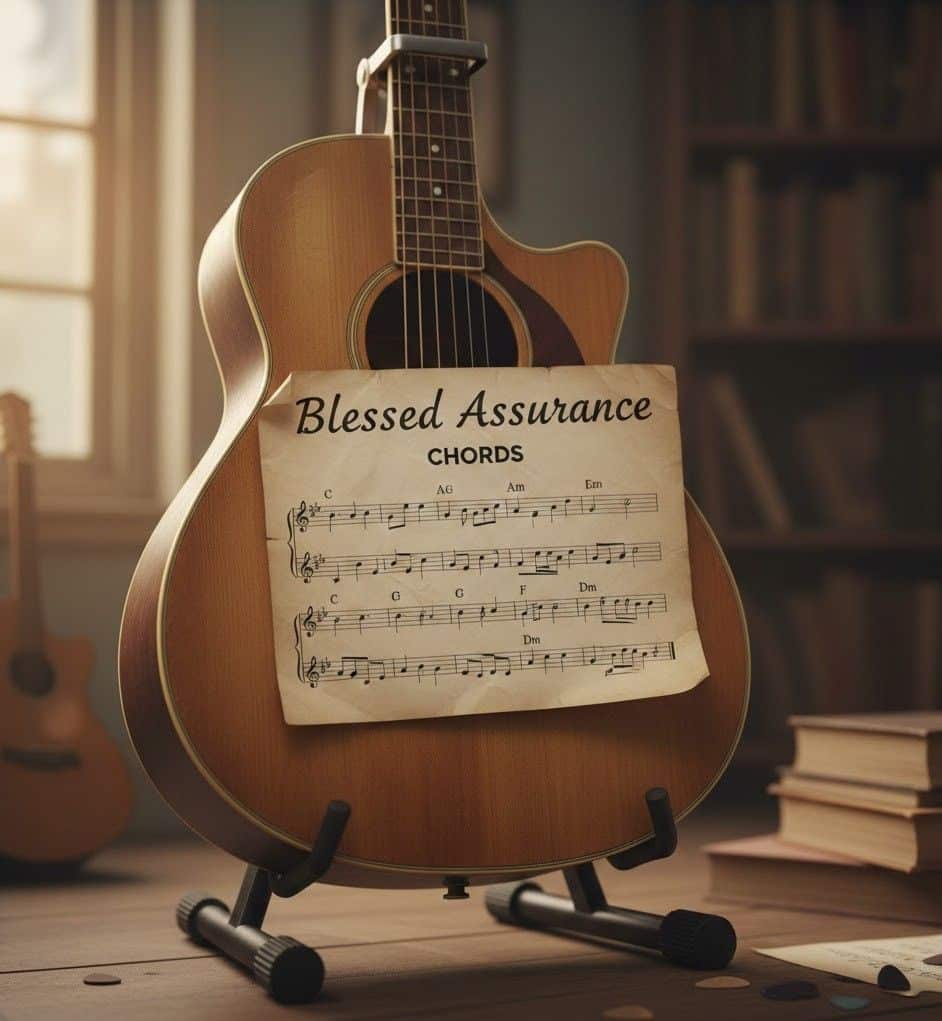

Blessed Assurance Chords
The timeless hymn “Blessed Assurance” has remained a cornerstone of Christian music for generations. It provides comfort and solace to countless believers worldwide. Because many musicians lead this song in worship, learning the chords for “Blessed Assurance” is a vital skill for any church instrumentalist. This beloved hymn’s rich history and soothing melody make it a favourite among musicians and congregations alike.

Musicians who want to play this cherished hymn must understand its chord progression. Whether you are a beginner or an experienced musician, mastering the chords of “Blessed Assurance” will enhance your musical expression and your connection with your audience.
Key Takeaways
-
Explore the history and significance of “Blessed Assurance” in Christian music.
-
Learn the basic Blessed Assurance chords and progression.
-
Discover various arrangements for guitar and piano.
-
Understand tips for playing with confidence and feeling.
-
Enhance your musical expression with this timeless hymn.
The Story Behind “Blessed Assurance”
In the 19th century, two devoted Christians, Fanny Crosby and Phoebe Knapp, created “Blessed Assurance.” Their collaboration produced a hymn that became a cornerstone of American church music. Although Fanny Crosby was blind since infancy, she became one of the most prolific hymn writers of her time. Additionally, Phoebe Knapp was a gifted composer and the wife of a Methodist minister.
Fanny Crosby and Phoebe Knapp’s Collaboration
The partnership between Fanny Crosby and Phoebe Knapp yielded many timeless hymns. They wrote “Blessed Assurance” in 1873, with Fanny Crosby crafting the lyrics and Phoebe Knapp composing the melody. Furthermore, their work together exemplifies the powerful synergy that occurs when talented individuals serve their faith. As Fanny Crosby once said:
“My heart is overflowing with a good theme; I recite my composing as I dictate a song.”
Consequently, their collaboration expressed their deep faith through art. This is evident in the way “Blessed Assurance” has resonated with believers for generations.
The Hymn’s Enduring Legacy
“Blessed Assurance” left an indelible mark on American church music. Its enduring popularity proves the timeless appeal of its message and melody. Moreover, translators have brought the hymn into numerous languages, and churches across the world continue to sing it today. As a result, it has inspired countless arrangements and adaptations.
The legacy of “Blessed Assurance” connects to the rich history of American hymnody. In fact, it stands as a reminder of how Crosby and Knapp contributed to the world of church music.
Mastering the Blessed Assurance Chords
To play the song effectively, a musician must grasp its basic musical components. Understanding the key signature, time signature, and primary chord progression ensures a meaningful rendition of this classic hymn.
Key Signature and Time Signature
Musicians typically play “Blessed Assurance” in the key of G major. This key adds a bright, uplifting quality to the music. Meanwhile, the time signature is 4/4, providing a steady, familiar pace for the congregation.
Primary Chord Progression
The primary chord progression for Blessed Assurance chords in G major is straightforward. Specifically, you can follow this progression:
| Section | Chord Progression |
| Verse | G – G – Em – Em – C – C – D – D – G – G |
This progression creates a sense of resolution. Therefore, it perfectly fits the hymn’s message of faith and assurance.
Chord Chart Notation
Chord charts offer a simple way to notate the chords. For this arrangement, the chart displays the chords G, Em, C, and D in a vertical alignment. Because reading these charts is a crucial skill, beginners should focus on the smooth transition from one chord to the next.
Verse and Chorus Blessed Assurance Chords
Understanding these specific progressions is vital for worship leaders. In addition, the harmony creates a sense of tension and resolution, enhancing the worship experience.
Verse Chord Structure
The verse chord progression follows a traditional pattern. Typically, the musician plays a simple, steady rhythm so the lyrics can take center stage. For example, the structure often uses an I-IV-V progression. In the key of G, this translates to G-C-D.
Chorus Chord Variations
In contrast, the chorus often introduces a slight variation to add complexity. While the verse sticks to a straightforward I-IV-V, the chorus might incorporate vi or ii chords. For instance, adding a vi chord (E minor) adds a touch of melancholy, highlighting the theme of reliance on faith.
| Section | Chord Progression | Key of G Example |
| Verse | I – IV – V | G – C – D |
| Chorus | I – vi – IV – V | G – Em – C – D |
Beginner-Friendly Blessed Assurance Chords
With beginner-friendly arrangements, anyone can start playing the song quickly. Since this hymn holds great spiritual significance, all musicians should feel welcome to learn it. By simplifying the chords in “Blessed Assurance,” beginners can focus on their playing technique.

Simple Three-Chord Version
You can achieve a simple version by focusing on the most essential chords: G, C, and D. This progression provides a solid foundation. As a result, beginners can play along without feeling overwhelmed by complex shapes.
Practice Tips for Beginners
-
First, start with a slow tempo and increase the speed gradually.
-
Next, focus on changing chords cleanly.
-
Finally, use a metronome to keep your timing consistent.
Piano and Keyboard Arrangements
Furthermore, pianists and keyboard players can explore multiple arrangements of “Blessed Assurance” to suit their skill level and musical style. Consequently, this flexibility makes the hymn accessible to a wide range of musicians, from beginners to advanced players.
Right-Hand Melody with Left-Hand Chords
For instance, a simple yet effective way to play “Blessed Assurance” is to use the right hand for the melody while the left hand provides chord accompaniment. Specifically, this method allows for a clear presentation of the hymn’s tune; as a result, it is highly suitable for congregational singing or personal devotion. In addition, to enhance the arrangement, consider adding arpeggios or broken chords in the left hand to create a more flowing accompaniment.

Conclusion
Sharing the Beauty of the Hymn
Mastering the chords for “Blessed Assurance” is a rewarding experience. It enhances your worship and your musical expression. In summary, this comprehensive guide provides the tools you need to play with confidence.
Finally, as you share your talents, you bring the beauty of this music to a broader audience. Whether you play on guitar or piano, you can adapt these chords to suit your unique style.


