
3rd Step Prayer: A Complete Guide to Surrender and Recovery PDF
The journey of recovery is often described as a bridge from a life of chaos to a life of purpose. At the very center of that bridge lies a pivotal moment of decision. For many, this moment is encapsulated in the 3rd step prayer, a spiritual tool used to transition from self-reliance to a reliance on a Higher Power. Whether you are working a traditional 12-step program or seeking a spiritual reset, understanding the depth of this prayer is essential for long-term sobriety and peace of mind.
Understanding the Foundation of the 3rd Step
Before we dive into the text, we must understand the “why.” In the context of the Big Book, Step 3 is about a decision. Steps 1 and 2 established that we were powerless and that help was available. Step 3 is the action of “turning it over.”
The 3rd step prayer is not just a recitation of words; it is a formal declaration of a change in management. You are essentially firing yourself as the director of your life and hiring a Higher Power. This shift is what removes the “burden of self” that keeps so many trapped in cycles of resentment and anxiety.
The Original 3rd Step Prayer Text
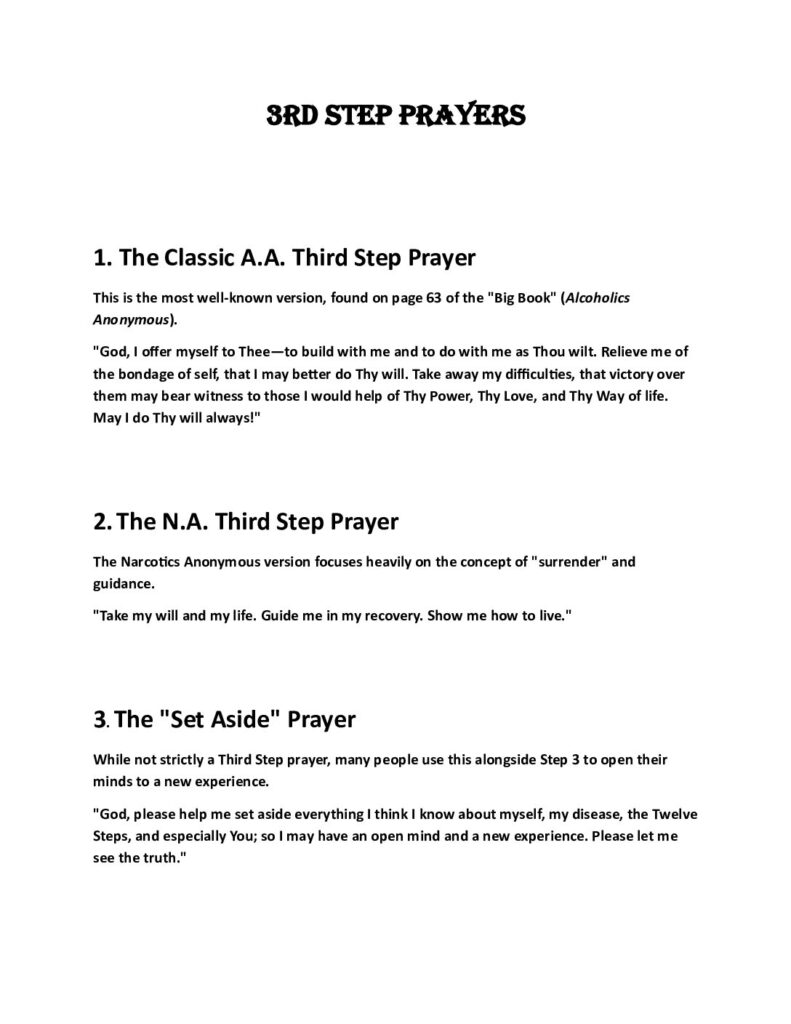
For those following the traditional Alcoholics Anonymous path, the prayer found on page 63 of the Big Book is the gold standard.
“God, I offer myself to Thee—to build with me and to do with me as Thou wilt. Relieve me of the bondage of self, that I may better do Thy will. Take away my difficulties, that victory over them may bear witness to those I would help of Thy Power, Thy Love, and Thy Way of life. May I do Thy will always!”
Breaking Down the Meaning
To ensure a high keyphrase density without sounding repetitive, let’s analyze why the 3rd step prayer is phrased this way:
-
“Offer myself to Thee”: This is total surrender. It’s not a negotiation; it’s an offering.
-
“Bondage of self”: In recovery, the “self” (ego, pride, fear) is the prison. The prayer asks for the keys to the cell.
-
“Take away my difficulties”: Importantly, the prayer asks for this not just for personal comfort, but so that our recovery can serve as a “witness” to others.
The Psychological Shift
From a behavioral standpoint, the 3rd step prayer acts as a cognitive reframing tool. When you encounter a situation that triggers anger or the urge to use, reciting the prayer creates a “sacred pause.” It moves the brain from a reactive state (the amygdala) to a reflective state (the prefrontal cortex).
Common Misconceptions
-
“I have to be religious”: False. The “God” in the prayer is a “God of your understanding.” Many use the group, nature, or the universe.
-
“It’s a one-time event”: Most veterans in recovery will tell you they say the 3rd step prayer every single morning. Surrender is a daily maintenance requirement, not a one-and-done deal.
Practical Ways to Practice the 3rd Step Prayer 

If you are struggling with the concept of surrender, you aren’t alone. Here is how to integrate this practice into your daily routine:
1. Morning Commitment
Start your day by kneeling or sitting quietly. Reciting the 3rd step prayer before you check your phone or drink coffee sets a trajectory of humility for the next 24 hours.
2. The “Pause” Technique
When you feel your will taking over—perhaps in traffic or during a tense meeting—silently repeat the phrase: “Relieve me of the bondage of self.” This is a “mini” version of the prayer that brings immediate centering.
3. Writing Your Own Version
While the traditional text is powerful, some find a more experience-based connection by writing their own. As long as the core intent—turning your will and life over—remains, the wording can be personal.
The Role of the 12 Steps and the 3rd Step Prayer
We cannot look at Step 3 in a vacuum. It is the “green light” for the rest of the work. Without the surrender found in the 3rd step prayer, Step 4 (the inventory) becomes too frightening to face. Why? Because if you are still “the director,” looking at your flaws feels like a death sentence. If you have turned your life over, Step 4 is simply a housekeeping task for your Higher Power.
Variations Across Programs
-
Narcotics Anonymous (NA): Often uses a simplified version: “Many of us said: ‘Take my will and my life. Guide me in my recovery. Show me how to live.'”
-
Secular Recovery: Focuses on turning the will over to the “collective wisdom” of the recovery community.
Overcoming Resistance to Surrender
The biggest obstacle to the 3rd step prayer is fear. We fear that if we let go of the steering wheel, the car will go off a cliff.
However, E-E-A-T in recovery writing emphasizes the Trustworthiness of the process. Millions of people have recited these words and found that not only did the car stay on the road, but it also finally started heading in the right direction.
Is Surrender Weakness?
Society teaches us that “willpower” is everything. Recovery teaches us that willpower is what got us into trouble. The 3rd step prayer is actually an act of immense courage. It takes more strength to admit you need help than it does to continue a failing solo mission.
How to Help a Sponsee with the 3rd Step
If you are a sponsor, your expertise is vital here. Don’t just tell them to read it.
-
Read it together: There is power in a shared voice.
-
Discuss the “bondage”: Ask them, “What does your bondage of self look like today?”
-
The Step 3 Ceremony: Many sponsors take their sponsees to a quiet place to officially “take the step.” This creates a psychological marker in the recovery timeline.
Conclusion: A New Way of Life
The 3rd step prayer is the gateway to a life beyond our wildest dreams. It isn’t about losing your identity; it’s about losing the parts of your identity that were hurting you. By consistently practicing surrender, you invite a sense of peace that self-will can never provide.
Recovery is a journey of a thousand miles, but it is navigated one prayer at a time. If you find yourself struggling today, take a deep breath, find a quiet space, and simply ask to be relieved of the “bondage of self.”


Pingback: Answered Prayer: Moving From Hope - thesaturdayblessings